The Hidden Tax on Every AI Product
Every AI product answer has a cost attached to it. The language model processes tokens, the tokens are billed by the provider, and the bill rises in lockstep with usage. For most vendors this condition is permanent, which means the unit economics they showed in the seed deck are the same unit economics they will be running on day three hundred and day three thousand.
Pitch decks do not dwell on this. Gross margins look generous at demo scale, where two reps fire off a few hundred queries between them. They look very different at production scale, where thousands of daily interactions per customer eat into the subscription faster than the subscription grew to cover them. The vendor then has three options, none of which the customer enjoys paying for: raise prices, throttle usage, or accept thinner margins until the thinness becomes unsustainable and prices rise anyway.
RevSprint's architecture was designed around a different economic model, captured in our pricing structure on the pricing page. The longer a customer uses the system, the less each interaction costs to serve. Not marginally less. Dramatically less.
How Intelligence Gets Cheaper
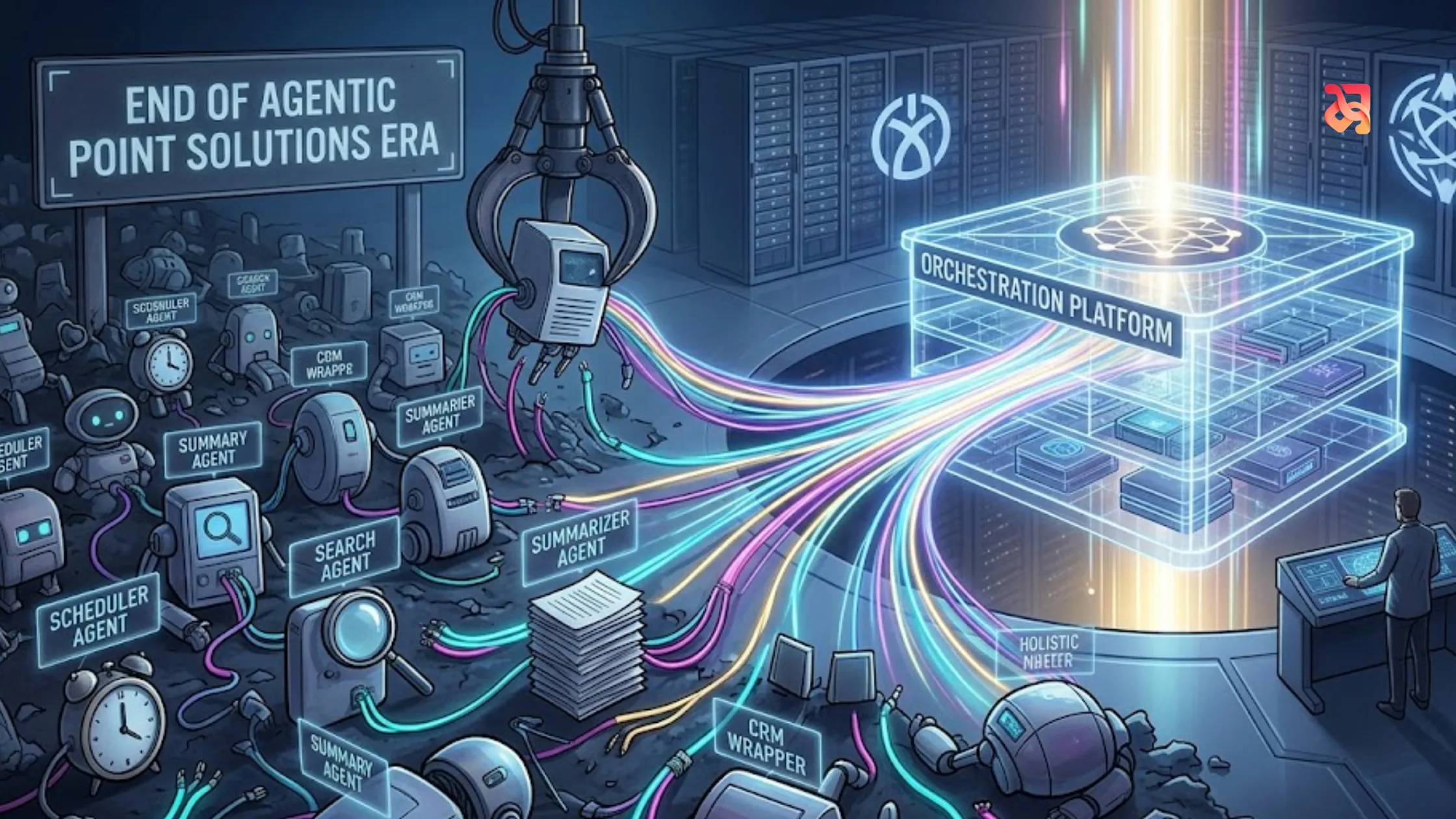
The mechanism is straightforward. When your team runs a workflow repeatedly, the system recognises the pattern. After enough successful executions, that workflow is promoted to a deterministic template. A template doesn't need a language model. It executes directly, with the same quality, at a fraction of the cost and latency.
This happens continuously, across every department. Sales follow-up sequences. Support ticket routing. Pipeline health assessments. Content approval workflows. Each one starts as an AI-powered process and graduates to a zero-AI-cost template once it's proven reliable. The intelligence that created the workflow persists. The per-execution cost drops to near zero.
- Every proven workflow graduates from AI-powered to deterministic execution, eliminating per-interaction token spend
- The system actively identifies patterns that can be promoted, without manual intervention from your team
- Graduated workflows run faster (no model latency) and cheaper (no token cost) while maintaining the same quality
- New scenarios still use the full intelligence layer; only proven, stable patterns graduate
- The result is a cost curve that declines with usage while the intelligence surface area grows
“The economics invert by design: by month twelve, routine actions run as graduated workflows without a model call, and the per-person AI cost falls to a fraction of month one.”
Why New Entrants Can't Match This
The declining cost curve is a compounding moat. A new competitor launching today pays full AI processing costs for every interaction, for every customer. RevSprint customers who've been on the platform for a year have hundreds of graduated workflows running at near-zero cost. The gap between a new entrant's unit economics and RevSprint's widens every day. The complement is self-evolving workflows, which describes the substrate underneath.
This isn't a pricing strategy. It's an architectural property. The system was designed so that intelligence compounds into efficiency. Every customer's usage makes the product more cost-effective, which protects margins, which funds deeper intelligence development, which creates more value, which drives more usage. It's a flywheel that competitors can only match by rebuilding their architecture from the data model up.
For the CFO evaluating AI investments: ask your vendor what happens to per-seat costs in year two. If the answer is 'they stay the same' or 'they increase with usage', the vendor has a linear cost structure that will eventually constrain either your usage or their margins. RevSprint's answer is different. Year two costs less than year one. Year three costs less than year two. That's the economic moat your board should care about. The Andreessen Horowitz analysis of the cost of intelligence tracks exactly this divergence between vendors with compounding versus linear unit economics. To put this on your own usage, get early access.