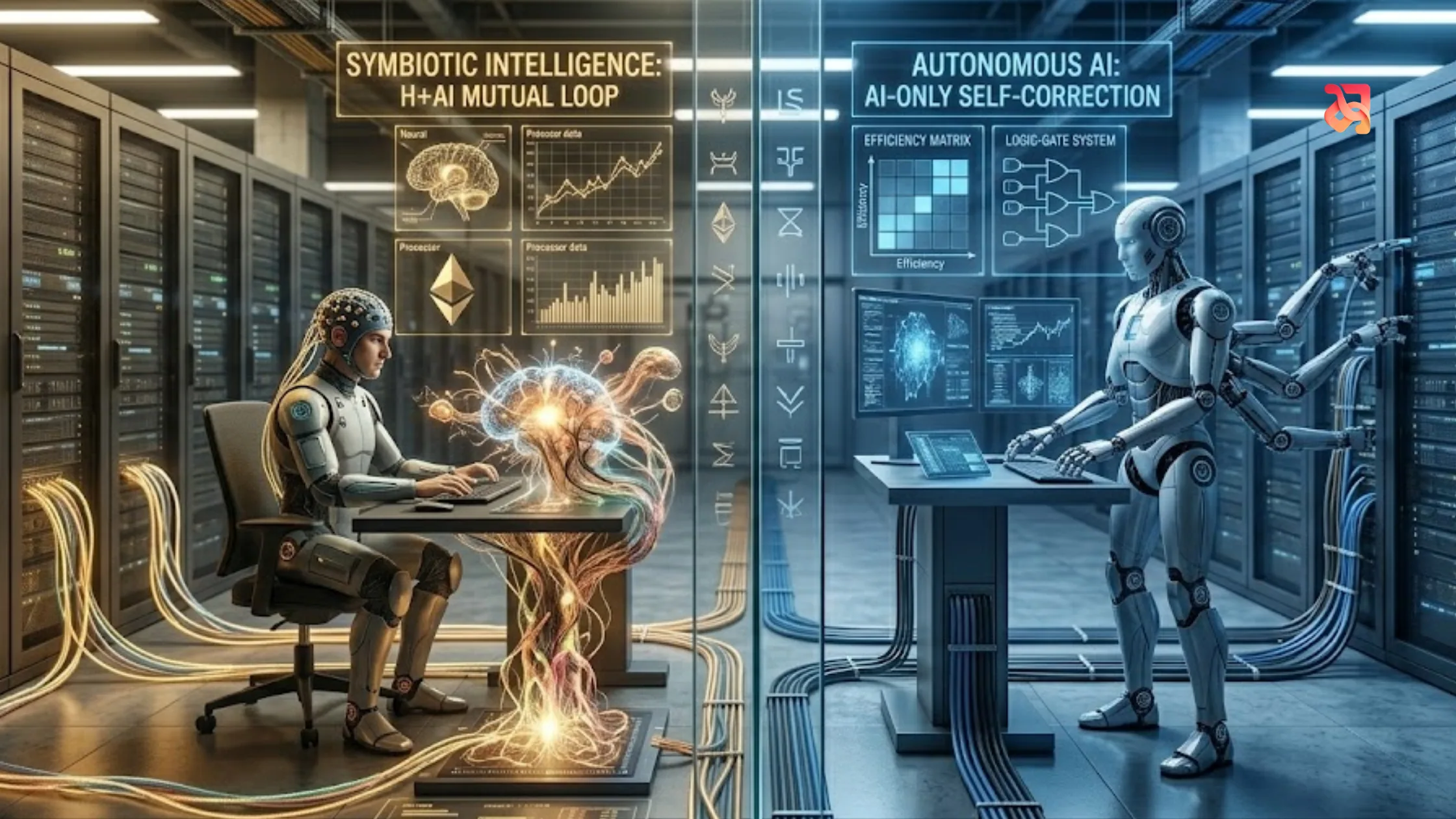
Symbiotic Intelligence and autonomous AI both aim to reduce manual work across revenue operations. They start from opposite premises. Autonomous AI optimises for independence: give it a goal, remove the human, let it execute. Symbiotic Intelligence optimises for interdependence: the AI brings cross-organisational context no human can hold, and the humans bring judgment no model can replicate. The two approaches produce fundamentally different outcomes at scale.
What Autonomous AI Actually Does
Autonomous agents read a prompt, generate a plan, call a sequence of tools, and return a result. The best implementations do this competently. Execution quality has stopped being the interesting question, which is why so much of the autonomous-agent literature reads like a benchmarking exercise. The interesting question is context scope, and that is where the architecture struggles.
An autonomous agent inside a CRM can only reason about CRM data. An agent inside a call-intelligence tool can only reason about call transcripts. These boundaries are structural, not configurable. The Stanford Institute for Human-Centered AI has documented repeatedly that AI systems operating without human oversight in high-stakes environments produce errors that compound faster than they can be detected. In enterprise revenue operations, a single misrouted email to a key account can undo months of relationship-building.
- Autonomous agents operate within a single tool’s data boundary, making them structurally blind to cross-departmental signals
- Errors compound silently because the agent cannot assess its own context gaps
- Trust is demanded upfront rather than earned through demonstrated accuracy
- No feedback mechanism exists to calibrate the agent’s judgment to your organisation’s specific patterns
What Symbiotic Intelligence Does Differently
RIBA reads every department, every communication channel, every entity, simultaneously. When it identifies a signal worth acting on, it does not execute silently. It surfaces the signal with full context, explains its reasoning, and proposes an action. Your team validates. Over time, RIBA calibrates to your organisation’s judgment patterns, promoting validated actions to higher autonomy tiers.
This is not a slower version of autonomy. It is a different architecture. The mesh processes signals across departments in under one second. The speed is comparable. The intelligence is categorically deeper because it operates across the entire organisation rather than within a single tool.
“We tested three autonomous sales agents before RevSprint. Each one was fast and confident and wrong about things it couldn’t see. The first time RIBA flagged a deal risk based on a support ticket the sales team didn’t know about, we understood the difference.”
The Structural Comparison
- Context scope: Autonomous agents see one tool. RIBA sees the entire organisation through its real-time event mesh
- Trust model: Autonomous agents demand trust on deployment. RIBA earns trust through progressive autonomy, with every action logged to an immutable audit trail
- Learning: Autonomous agents don’t learn from your team’s overrides. RIBA’s calibration loops encode your judgment into the system
- Cost trajectory: Autonomous agents cost the same per call indefinitely. RIBA promotes successful patterns to zero-cost deterministic templates, reducing operating costs over time
- Accountability: Autonomous agents log actions. RIBA traces every action to revenue outcomes through the ROI Ledger
When Autonomy Makes Sense
Autonomous AI works for isolated, repeatable tasks where context is narrow and errors are cheap. Data entry, appointment scheduling, basic routing. These are legitimate applications.
But revenue operations is not an isolated task. A deal involves sales, marketing, support, finance, legal, and product signals. A follow-up email is shaped by the last support interaction, the contract renewal date, the competitor activity, and the sentiment trajectory. Autonomy applied to this complexity without cross-departmental context is not automation. It is gambling with your customer relationships.
Symbiotic Intelligence is what happens when you build the context layer first and add graduated autonomy on top. The result is AI that your team trusts enough to actually use, which is the only kind that generates real value.