The silos did not go away. The AI sat on top of them.
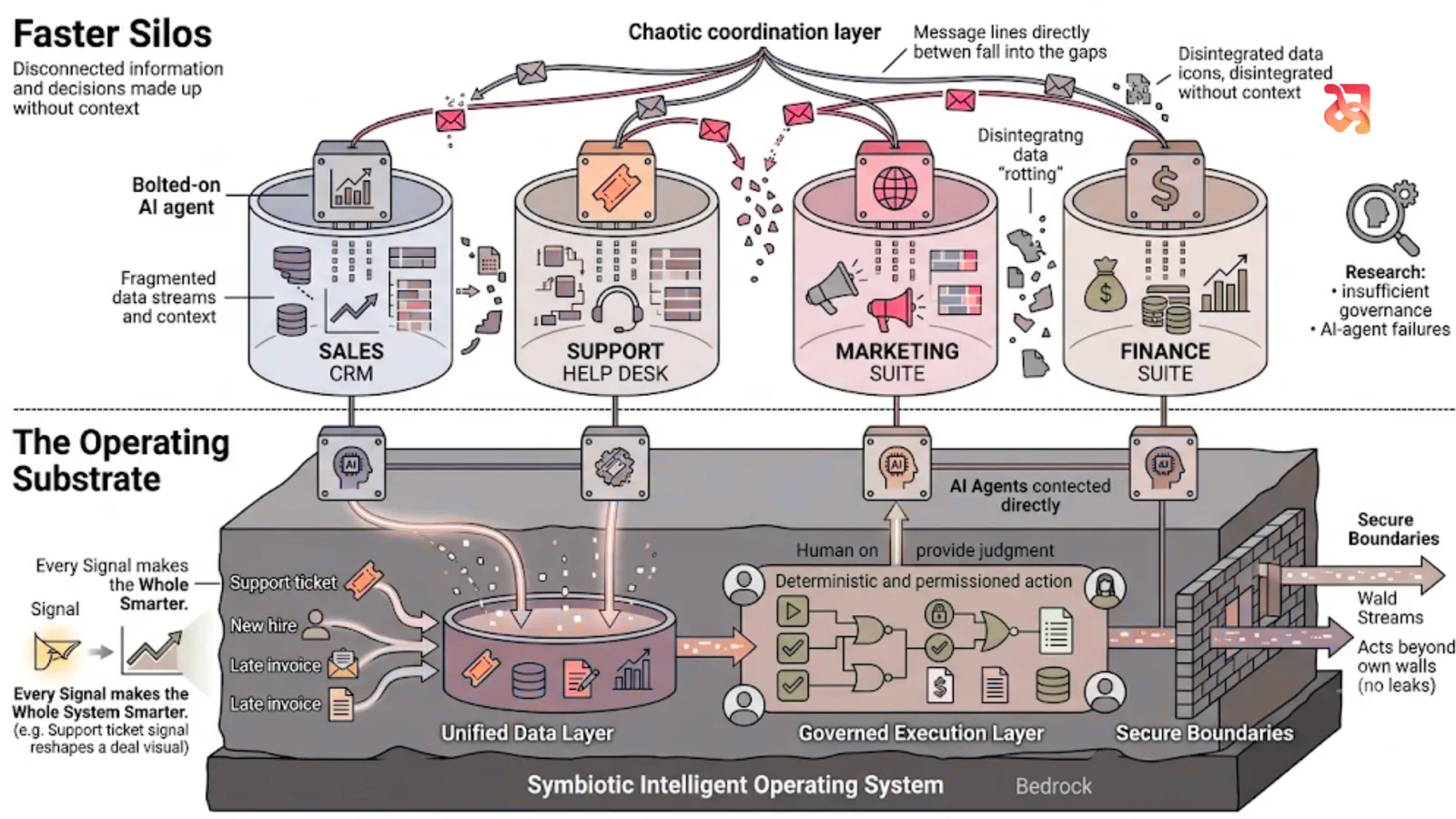
For two years the enterprise response to AI has been to add it to whatever tool already existed. The CRM got an assistant. The help desk got an assistant. The marketing suite, the finance suite, and the analytics suite each got one too. Every assistant is competent inside its own walls and blind to everything outside them. The silos that fragment a business were not dissolved. Each was handed an AI of its own.
The result is faster silos. Sales AI accelerates the sales silo. Support AI accelerates the support silo. The work still falls through the same gaps between them, only now it falls through faster.
Multi-agent orchestration is a Layer 2 answer to a Layer 1 problem
The industry has noticed the chaos, and its answer is multi-agent orchestration: give each tool an agent, then add a coordination layer on top that passes messages between them. It is a reasonable instinct, and it is the wrong layer. Orchestration sits at Layer 2. It assumes a Layer 1 already exists: a shared, real-time picture of the whole organisation that every agent can read from and write to. When that foundation is missing, orchestrated agents recreate the very silos they were meant to remove, with disconnected information, duplicated effort, and decisions made without context.
- Layer 2, orchestration: agents tied to tools, coordinated by passing messages. Only ever as good as the shared context beneath it.
- Layer 1, the operating substrate: one live picture of every signal across every department, with governed execution and security built in. The thing orchestration assumes but rarely builds.
The analysts now describe the same failure mode from the outside. Gartner projects that by 2030 roughly half of AI-agent failures will trace to insufficient governance and multi-system interoperability rather than to model capability. MIT's research on enterprise AI found the large majority of GenAI pilots delivering no measurable return. The model was rarely the problem. The missing operating layer was.
“The hard problem was never making an agent smart. It was giving the whole organisation one shared, real-time truth for the agents to act on. Build that substrate first, and orchestration becomes almost trivial. Skip it, and no amount of orchestration saves you.”
What an operating substrate actually owns
Operating-system-grade software owns three things. A unified data layer, so every part of the business reads from one live source instead of many stale copies. A governed execution layer, so actions are deterministic, permissioned, and logged rather than improvised by a model. And the secure boundaries to the outside world, so the system can act beyond its own walls without ever leaking what sits inside them.
RevSprint owns all three at the intelligence layer. That is the difference between a coordination layer bolted on top of disconnected tools and a Symbiotic Intelligent Operating System, the operating substrate the AI era was missing: one shared picture, governed execution, and secure boundaries, with humans providing the judgement the model cannot.
Why this is the question that decides everything
An AI added to a single tool can only ever be as smart as that tool's data. An orchestration layer can only ever coordinate what the agents beneath it can see. A substrate changes the ceiling, because every signal makes the whole system smarter, not just the part that received it. A support ticket changes the deal it threatens. A late invoice changes the renewal it endangers. A new hire changes the pipeline it reshapes. None of that is reachable by stitching tool-bound agents together after the fact. It has to be built underneath them.
This is why we did not build another assistant, and we did not build an orchestration layer. We built the substrate. You can read how that defines a new category in What Is Symbiotic Intelligence, and how it differs from the autonomous-agent and copilot patterns in Beyond Autonomous Agents. To see the substrate running on your own stack, get early access.