A Burrow Built for Two
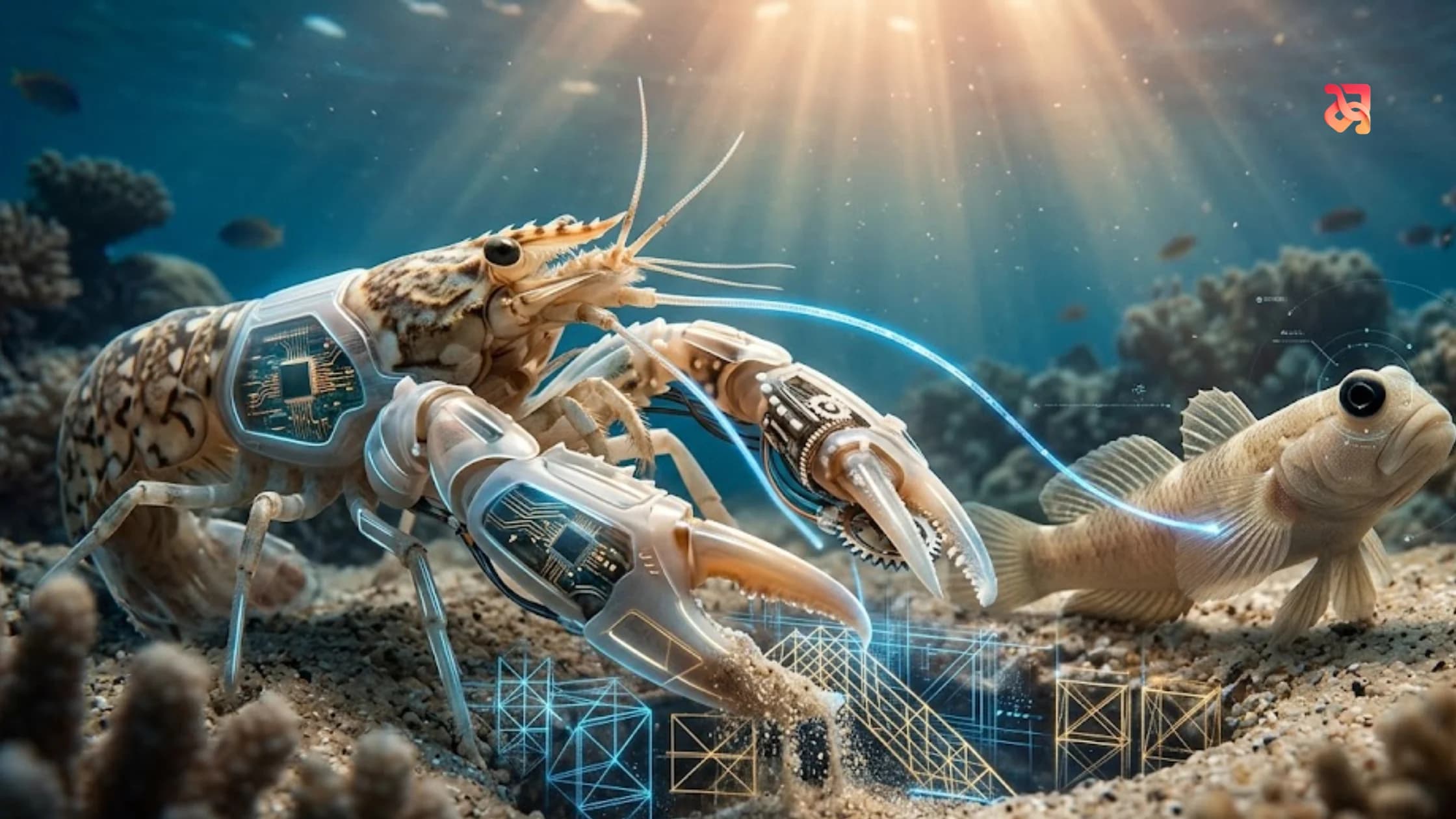
Venture into the shallow, sunlit waters of an Indo-Pacific reef, and watch the sandy seabed for a few patient minutes. You will witness one of the most extraordinary partnerships in the natural world.
The pistol shrimp is an industrious creature, capable of excavating complex, defensible burrows in shifting sand. Yet it has one critical vulnerability: it is almost entirely blind. Out in the open, it cannot see the predators patrolling the reef. Alone, it would not last a season.
The shrimp does not live alone. It shares its burrow with the watchman goby, a small fish with exceptionally sharp eyesight. The shrimp digs and maintains the architecture. The goby stands guard at the entrance. While the shrimp works, it keeps one antenna in constant contact with the goby's tail. At the first sign of danger, the goby flicks its tail, the signal travels down the antenna in a fraction of a second, and both animals dart safely inside.
The shrimp has the raw power to build and execute. The goby has the vision, the context, and the judgement. Neither survives this environment alone. The arrangement is brilliantly simple and profoundly effective. It has been running, unchanged, for millions of years.
This is what real symbiosis looks like. And it is the exact shape the enterprise has been failing to build.
Why Both Sides of the AI Debate Have Failed
For the past three years, the software industry has pushed two flawed models of human-AI work onto enterprise buyers. Neither models the burrow. Both eventually collapse. The first failure is the tethered model, where the AI sits inside a single tool and waits for instructions. The human is forced to be both the shrimp and the goby at once: digging the data, reading the room, switching context, prompting, editing, reviewing. The AI is a chisel, not a partner. We unpack why this falls apart at scale in Symbiotic Intelligence vs Copilot AI.
The second failure is the reckless model, where autonomous agents are turned loose to write emails, update the CRM, and trigger workflows with no human in the loop. This is the shrimp leaving the burrow alone. Predictably, it walks straight into predators. It hallucinates data, contradicts an email a teammate sent yesterday, and contacts the wrong account on the wrong day. We covered the structural reasons for this in Beyond Autonomous Agents.
Both extremes are evolutionary dead ends because they lack the defining feature of biological success: mutual dependence.
The Shared Burrow: How RevSprint Divides the Work
Symbiotic Intelligence is the architecture that mirrors the shrimp and the goby. Each side does what it is physiologically best at, and neither operates without the other.
- The AI builds. RIBA reads across eleven departments and your entire software stack at once, tracking OS-level context as you move from email to ERP to a customer call. It carries the heavy load: millions of signals, hidden friction in a supply chain, the stalled deal that nobody flagged. No human can process this volume of raw information in real time.
- The human watches. RIBA cannot read a room. It cannot feel the tension in a client's voice or weigh the politics of a major negotiation. At every high-stakes moment, the system surfaces the decision to a person, with full context attached. The person decides. The AI executes.
- The antenna stays in contact. Every approval, every correction, every override flows back into the system's immutable audit ledger. The AI calibrates to your company's behaviour, risk tolerance, and customer base. The flick of the tail teaches the burrow.
“Intelligence in the modern enterprise is not about replacing the human mind. It is about coupling the boundless processing power of the machine with the irreplaceable strategic vision of the human. One builds the foundation. The other surveys the horizon.”
Why the Feedback Loop Is the Real Innovation
The dramatic part of the shrimp and goby story is the warning: the flicked tail, the dart for safety. But the quiet part is more important. The constant antenna contact. The shrimp is never out of touch with its watcher.
In most enterprise AI today, the feedback loop is broken or absent. A copilot suggests an email. You either send it or you do not. The system has no idea what happened next, or why. An autonomous agent fires off a sequence and reports a vanity metric. Nobody knows which of its actions actually moved the deal. RevSprint closes the loop. Every action is logged to a cryptographically sealed, hash-chained audit ledger. Every approval and every override is captured. Outcome attribution traces which AI actions contributed to closed revenue, and which ones merely added noise. This is the substrate behind Progressive Autonomy: the system earns more authority only as your team validates more of its judgement. Trust is built through evidence, not promises.
The research backs the pattern. Stanford HAI's work on human-AI collaboration consistently finds that feedback-rich, structurally interdependent systems outperform both pure automation and pure manual work, across domains as varied as medical diagnosis, legal review, and complex sales.
Evolution Favours the Symbiotic
We are leaving the novelty phase of enterprise AI and entering the era of deployment, governance, and measurable return. The organisations that win the next decade will not be the ones that replace their teams with blind autonomous bots. Nor will they be the ones clinging to reactive, siloed tools that still leave the human to dig the hole. The winners will be those who build the shared burrow.
The AI filters the noise, connects the disparate tools, and executes the deterministic work. The humans bring empathy, strategy, and context. The system grows sharper. The team gets faster. The whole organisation evolves into a single, highly adapted organism. We argued the same point at the network layer in What Symbiosis Teaches Enterprise AI. At the dyadic layer of human and AI working side by side, the answer is the same.
Nature solved this long before we built our first database. It is time the enterprise caught up. To see the shared burrow running on your own stack, get early access.