Beneath the Forest Floor
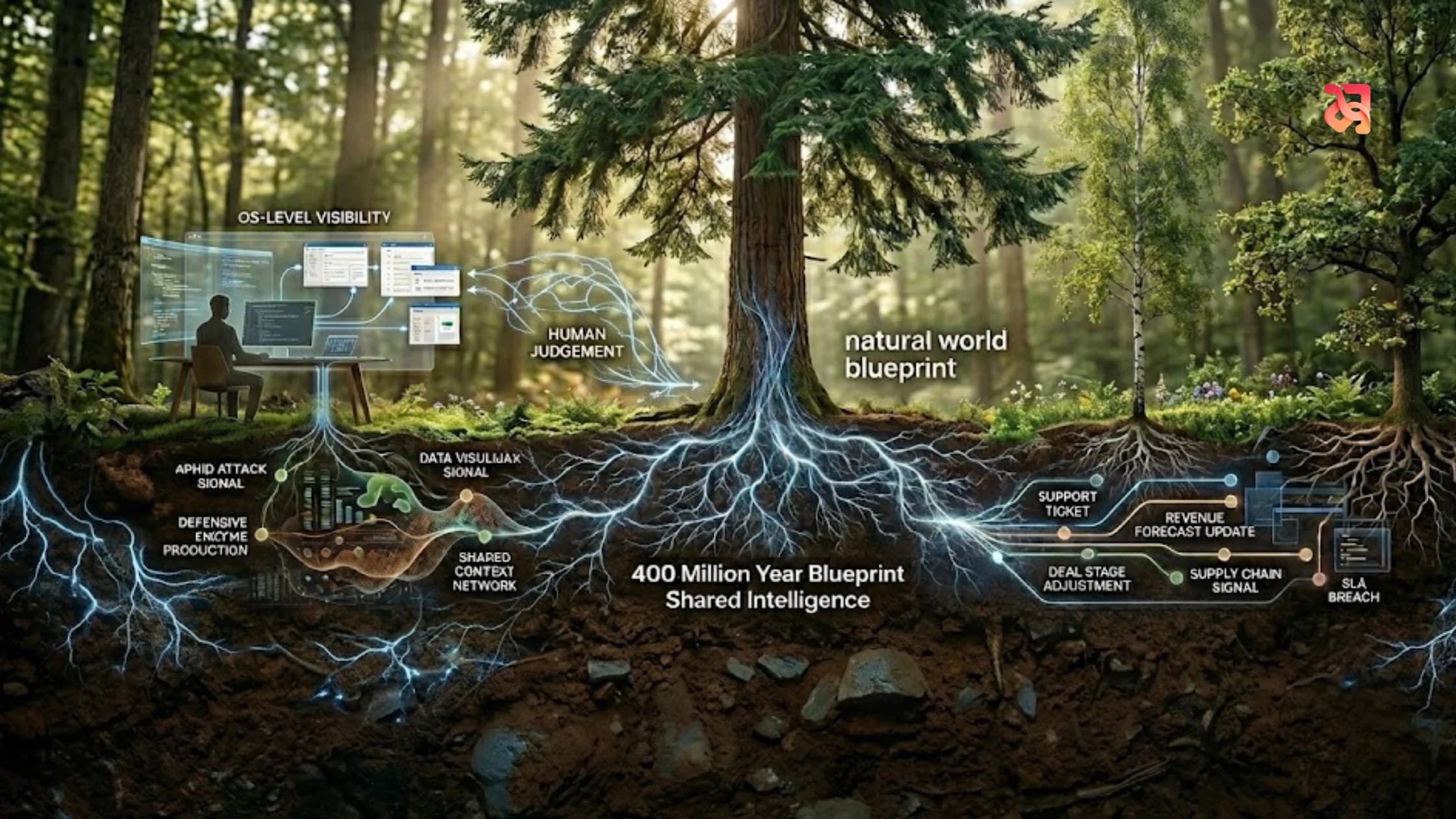
If you step into an ancient woodland, you are not simply walking above soil and roots. You are walking above an information highway that has been running for more than 400 million years. Microscopic threads of mycorrhizal fungi (often called the Wood Wide Web) connect almost every tree, in many cases across species.
When a single Douglas fir is attacked by aphids, it does not suffer alone. It releases chemical distress signals into the fungal network, and within hours neighbouring trees, even trees of entirely different species, begin producing defensive enzymes. The fungi gather the unseen context of the forest. The trees execute the response. Neither survives at full capacity without the other.
This is symbiosis. A continuous loop of shared intelligence built on mutual dependence. The tree cannot see the entire forest. The fungi cannot photosynthesise. Bound together, they thrive.
The Modern Enterprise Is a Forest With Its Roots Cut
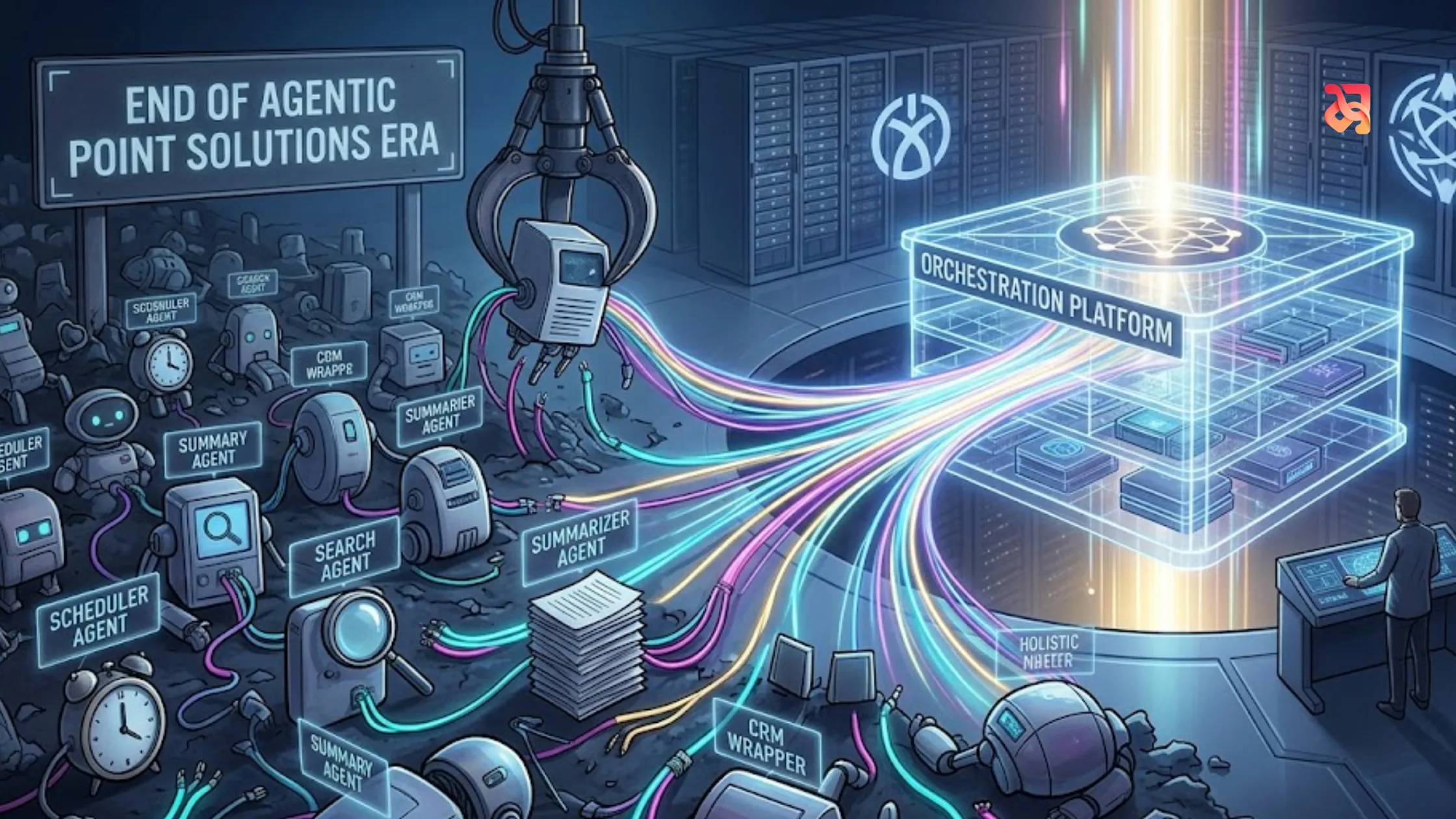
Now look at the average enterprise. The CRM knows nothing of the support desk's struggles. The marketing platform is blind to supply chain bottlenecks lingering in the ERP. The finance system has no idea a key account just escalated three tickets in twenty-four hours. There is no fungal network. Every tool is a tree cut off from the soil. As we explored in The AI Wrapper Problem, bolting language models onto isolated tools cannot fix this. Wrappers inherit the host tool's data boundary. They cannot see what they were never designed to see.
When a real threat appears, a usage drop from a top account, an SLA breach hidden in a long email thread, a relationship souring across weeks of small signals, no network passes the message. Blindness is the default state of the modern organisation.
The market's two attempted answers have both failed. Copilots wait for you to ask, then summarise what one tool already knows. Autonomous agents act fast on incomplete context and cause damage at machine speed. Neither possesses the quiet, brilliant efficiency of the woodland network.
Why Symbiosis Is the Architecture Evolution Selected
Evolution does not favour fragmentation. It favours symbiosis. Lichen are a fungus and an alga living as one organism. Coral reefs are animals hosting photosynthetic algae. The human gut contains trillions of microbes we cannot live without. The pattern repeats across biology because it works.
This is the principle behind Symbiotic Intelligence. RevSprint is the enterprise equivalent of the mycorrhizal network. We call the category a Symbiotic Intelligent Operating System. Three structural properties make it work.
- Omnipresent visibility. Like fungal threads weaving through every grain of soil, RIBA reads every signal across eleven departments simultaneously. A pipeline change, a sentiment shift in support, a sudden drop in product usage. The system reacts inside a second.
- Human judgement at the canopy. The AI carries organisational omnipotence. Humans bring empathy, nuance, and the ability to read a room. The two layers are designed to be incomplete without each other, exactly like fungi and trees.
- A continuous calibration loop. Every approval, override, and edit feeds nutrients back into the network. The system grows sharper the longer your team uses it. The AI learns to filter the noise specific to your organisation. The humans get faster because the AI surfaces only what matters.
Research backs the pattern. Stanford HAI's work on human-AI collaboration consistently finds that structurally interdependent teams outperform either pure automation or pure manual work. The strongest results come from systems designed for mutual dependence from day one.
“A species that tries to survive entirely in isolation goes extinct. The modern enterprise is no different. We have to move beyond AI that mimics us and build systems that genuinely live in symbiosis with us.”
What This Looks Like in Practice
A support ticket arrives in one department. Inside the same heartbeat, the account health score adjusts, the probability on the active sales deal shifts, the tone of an outbound marketing sequence changes, and the CSM sees a flag on tomorrow's call list. Nothing was synced. Nothing was batched. The whole organism reacted. This is the behaviour we detail in Introducing RevSprint and the contrast we draw against the autonomous agent wave in Beyond Autonomous Agents.
The difference is architectural, not cosmetic. You cannot bolt symbiosis onto a stack designed for silos any more than you can wire a forest's intelligence onto a row of potted plants.
Symbiosis Does Not Stop at the Wall
A forest's mycorrhizal network does not stop at a single tree. It connects entire ecosystems. The same principle extends inside RevSprint. Orbit carries the intelligence layer onto your customer-facing surfaces, so your buyers experience the same connected reasoning your team does. Inter-RIBA lets RevSprint instances perform cryptographic handshakes with other RevSprint instances to negotiate quotes, share logistics, and resolve support tickets autonomously. Two distinct ecosystems merging to share resources, exactly like overlapping mycorrhizal networks in adjacent woodlands.
The point is not that AI can act faster. The point is that the network is alive. A signal that originates in your customer's support thread can reach your sales rep, your CSM, and your CFO before the next pipeline review, because the underlying fabric was designed for it.
The Next Evolutionary Leap
Point solutions are evolutionary dead ends. They do not compound. They add noise to an already deafening ecosystem. Autonomous agents without context are reckless. Tools that wait for you to ask are merely faster typists.
The companies that survive the next decade will be the ones that build like the forest. Shared intelligence. Mutual dependence. Continuous calibration. To go deeper on the category itself, read What Is Symbiotic Intelligence. To see RevSprint reading your existing stack inside a working day, get early access. The symbiotic era is here. We invite you to grow with it.